
Learn Genetics
Plain-language explanations of what genetics actually means, how the different genetic tests differ, the inherited conditions most relevant in India, and how genetics intersects with pregnancy — written for patients and families, not just clinicians.
Genetics Explained
What genes, DNA and chromosomes actually are, in plain language.
Genetic Tests Explained
Common tests compared side by side — what each looks at, when it's used, and its limits.
Common Genetic Conditions
The inherited blood, chromosomal and metabolic conditions seen most often in India. Most Common Genetic Conditions in India
Pregnancy & Genetics
Chromosomal conditions in pregnancy, recurrent pregnancy loss, and pre-eclampsia.
Genetics Explained
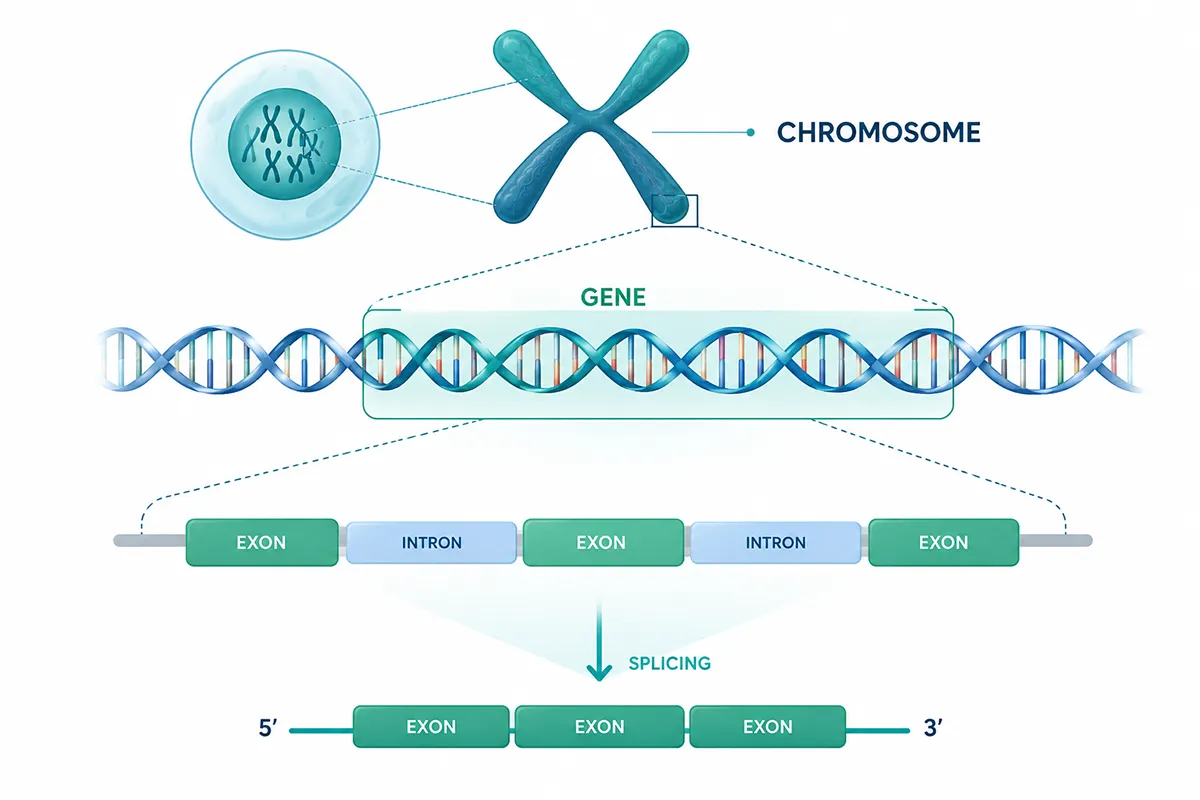
Genetics is the study of genes—the instructions in our cells that are passed from parents to children. Genes are made of DNA and arranged into 46 chromosomes. They influence how our body grows, functions and develops. Changes in genes can sometimes cause inherited health conditions.
Which test looks at what
Genetic tests differ enormously in what they can detect, how they work, and when they're the right choice. Each is tagged by what kind of test it is, so you can see at a glance how it's typically used.
Stains and counts all 46 chromosomes under a microscope; detects whole/large chromosome changes.
Down syndrome, recurrent miscarriage, Turner/Klinefelter, leukemia work-up.
Cannot detect changes smaller than ~5–10 Mb; needs live, dividing cells.
Analyses cell-free fetal DNA circulating in maternal blood to screen for common chromosome aneuploidies.
High-sensitivity prenatal screening from 10 weeks onward for Down, Edwards, Patau and sex-chromosome conditions; avoids a procedure-related miscarriage risk.
A screening test, not diagnostic — positive results need confirmation via CVS/amniocentesis and QF-PCR/karyotype; can be affected by low fetal fraction, twin pregnancies, maternal mosaicism.
Scans the whole genome for extra/missing DNA segments (copy number changes) at much finer resolution than karyotype.
Unexplained developmental delay, autism, multiple congenital anomalies — first-line for such children.
Cannot detect balanced rearrangements, single-gene mutations, or triploidy; misses very low-level mosaicism.
Fluorescent probes bind to a specific, targeted chromosome region to confirm or rule out one known change.
Confirming a specific microdeletion (e.g., 22q11), sex chromosomes, rapid prenatal aneuploidy check.
Only detects the region the probe is designed for; not a genome-wide scan.
Rapidly counts copies of markers on chromosomes 13, 18, 21, X and Y from a small DNA sample.
Rapid prenatal screening for common aneuploidies (Down, Edwards, Patau) from CVS/amniotic fluid.
Limited to the chromosomes tested; does not detect structural or other chromosome changes.
Sequences the protein-coding regions (~1–2% of the genome) where most known disease-causing variants lie.
Undiagnosed genetic conditions, multi-system disorders, when a specific gene is not suspected.
Misses non-coding/regulatory variants; variants of uncertain significance are common; may need trio (parents+child) testing.
Sequences a curated subset of ~4,000–7,000 medically well-characterised genes rather than the full exome.
Cost-effective first step when a genetic cause is suspected but the gene is unknown among known disease genes.
Narrower gene coverage than WES; may miss novel/rare genes not yet in the panel.
Sequences essentially the entire genome, coding and non-coding regions alike, at base-pair resolution.
Complex or unsolved cases after WES/CES is negative; research and structural variant detection.
Highest cost and data complexity; interpretation of non-coding variants still evolving; longer turnaround.
Reads the exact DNA letter sequence of one specific, targeted gene region.
Confirming a known familial mutation; single-gene disorders with a clear suspected gene.
Only tests the targeted region; impractical for scanning many genes at once.
Detects extra or missing copies of specific exons/genes using multiplexed probes.
Detecting deletions/duplications in known genes (e.g., DMD, SMN1) not picked up by sequencing.
Only detects copy-number changes in the targeted probe set; not a sequencing method.
Amplifies across trinucleotide repeat regions to size and flag expanded repeats.
Screening/confirming repeat-expansion disorders (e.g., Fragile X, myotonic dystrophy, Huntington's disease).
Designed for specific repeat disorders only; very large expansions may need supplementary sizing methods.
What shows up most often in India
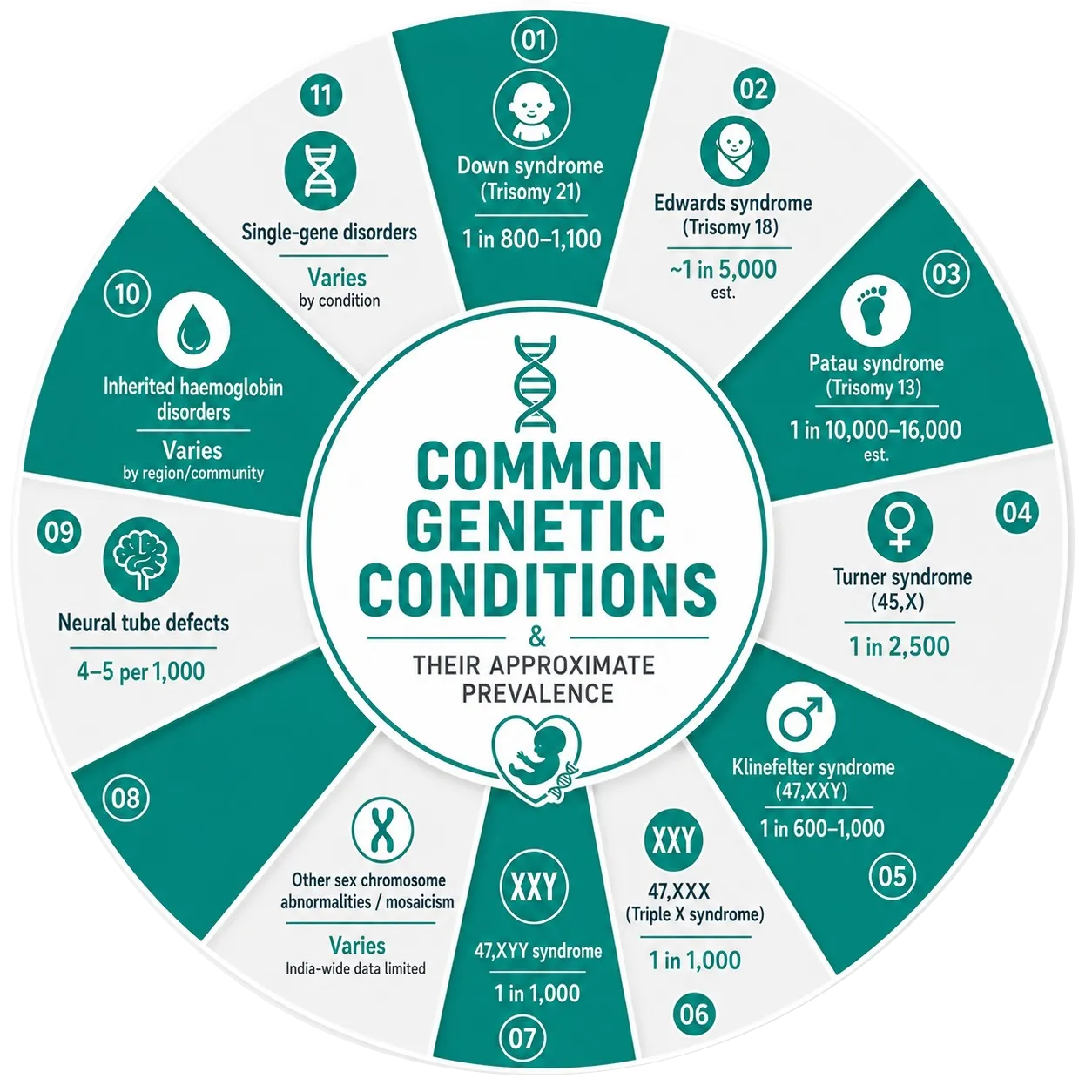
India's large and genetically diverse population has a wide range of inherited conditions. Consanguinity in some communities can increase the risk of recessive disorders, while a large heterozygous carrier population and migration between regions can spread genetic variants across communities. Together, these factors contribute to the country's significant burden of inherited blood, chromosomal and other genetic disorders.
β-Thalassemia trait
About 1 in 25–33 people is a carrier nationally; community rates can be substantially higher. (PMC)
Sickle Cell Trait
About 1 in 17 people in pooled Indian studies; much higher in some tribal/central Indian populations. (ScienceDirect)
Sickle Cell Disease
Roughly 1 in 85 in the pooled literature, but highly concentrated geographically and ethnically. (ScienceDirect)
G6PD deficiency
About 1 in 20 in pooled Indian studies, with marked regional variation. (PubMed)
Down syndrome (Trisomy 21)
Approximately 1 in 800–1,150 births in Indian studies. (PubMed)
DMD / SMA
Useful as a regional estimate, not a national prevalence. (PMC)
Lysosomal Storage Disorders (LSDs)
Includes Gaucher, Fabry, Pompe, MPS and others. Indian diagnostic cohorts show substantial underdiagnosis. (PubMed)
Gaucher disease
Among the more frequently diagnosed LSDs in Indian genetic centres. (PubMed)
Pompe disease
Rare and frequently underdiagnosed; both infantile and late-onset forms occur. (PubMed)
Fabry disease
Often missed because symptoms can appear across multiple organs and may present in adulthood. (PubMed)
Fragile X syndrome
A significant inherited cause of intellectual/developmental disability; prevalence estimates vary by study population.
Familial Hypercholesterolemia
Likely substantially underdiagnosed; population-based Indian data remain limited.
Neural Tube Defects
Roughly 0.3–0.5% of births, with considerable regional variation.
IEMs collectively
Includes amino-acid disorders, organic acidemias, fatty-acid oxidation disorders and others; newborn-screening data are still limited.
Genetics across pregnancy
From routine screening to recurrent loss and pre-eclampsia, genetics plays a role at several points across a pregnancy — here's what's most relevant to know at each.
Chromosomal abnormalities in the pregnancy
Why it matters — Chromosomal abnormalities are a common cause of early pregnancy loss.
Evaluation — Genetic testing of pregnancy tissue can identify chromosomal abnormalities in the lost pregnancy.
Parental chromosomal rearrangements
Why it matters — A parent may carry a balanced translocation without having any symptoms but may have an increased risk of miscarriage.
Evaluation — Genetic consultation can help identify this and guide the couple for future reproductive planning.
Recurrent miscarriage with a normal parental karyotype
Why it matters — Many couples with RPL do not have a detectable chromosomal rearrangement.
Evaluation — Testing the pregnancy tissue can provide more useful information about whether the loss was chromosomal.
Family history / known genetic condition
Why it matters — A previous child or pregnancy affected by a genetic disorder can change recurrence risk.
Evaluation — Genetic counselling and targeted testing may be appropriate before the next pregnancy.
Consanguinity
Why it matters — Increases the chance that both partners carry the same recessive variant.
Evaluation — A genetic consultation can help guide the couple for reproductive planning.
Multiple losses or an affected pregnancy
Why it matters — Repeated losses warrant a broader assessment rather than assuming each loss was random.
Evaluation — A genetics consultation can help decide whether parental karyotyping, pregnancy-tissue testing or other testing is appropriate.
- Indian studies report wide variation in prevalence, depending on whether data come from community surveys, hospital records or high-risk referral centres.
- Hypertensive disorders of pregnancy are an important contributor to maternal and perinatal complications, including preterm birth, fetal growth restriction and stillbirth.
- Pre-eclampsia is not itself a genetic disorder, but family history, maternal cardiovascular/metabolic factors and some genetic susceptibility can influence risk.
- Early antenatal care and appropriate screening are important for identifying women at increased risk.